
5 Types of Stories That Work Best as AI Comics (and Why)
Not every novel adapts equally well. Here are the story types that produce the strongest comic pages, and what makes them click.
Why this matters
AI comic generation works by reading a chapter, splitting it into beats and drawing them as four-panel pages. Stories that are rich in physical action, distinct characters, and clear locations give it the most to work with — and produce the most satisfying pages.
Action and adventure stories
Stories with physical movement — fights, chases, escapes, battles, journeys — are the most natural fit for comic adaptation. Each moment is already its own visual event. A character leaping across a rooftop, a sword strike catching the light, a ship entering a storm harbor — these scenes are built for panels.
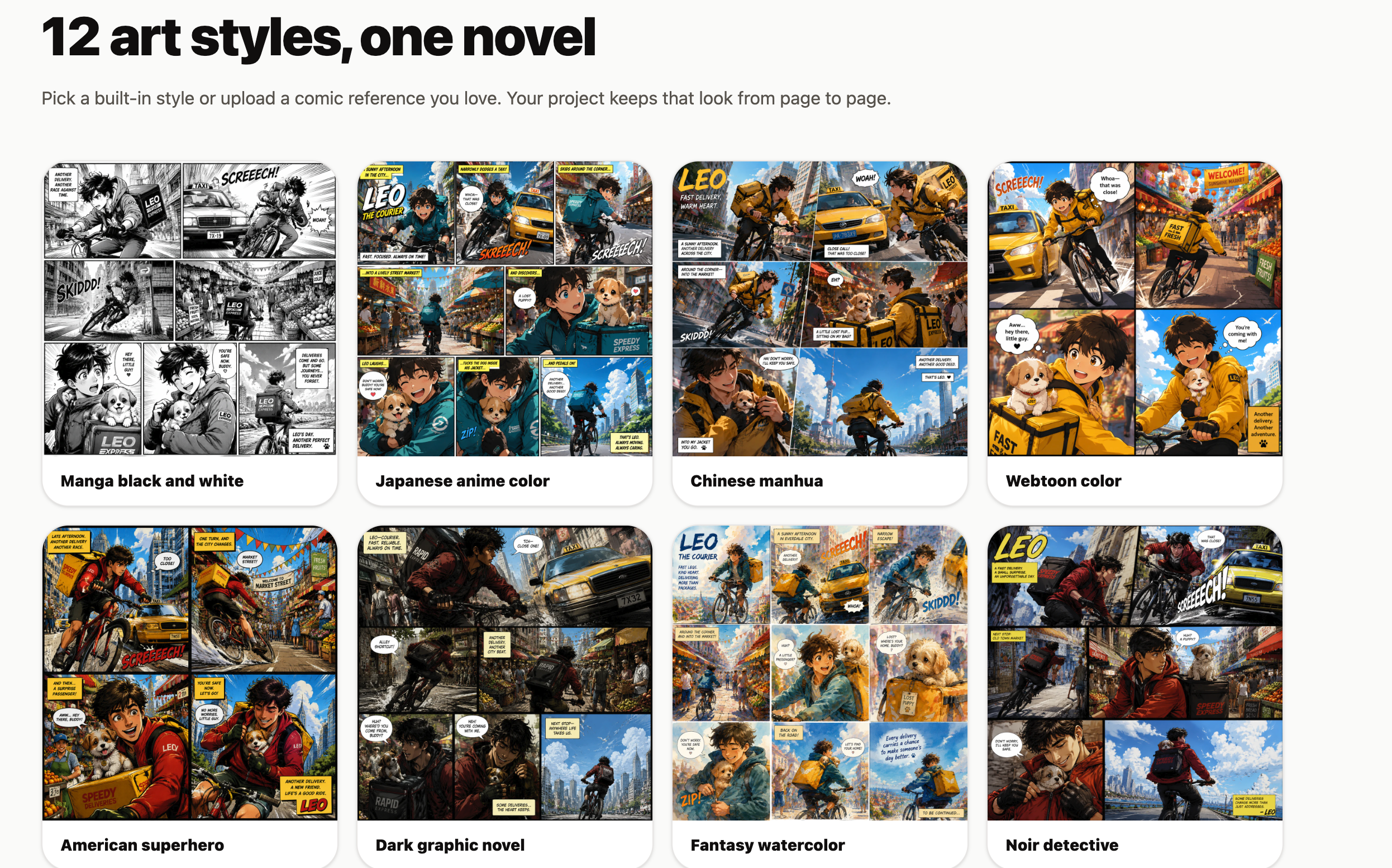
Vibrant shonen anime suits large-scale fights and power clashes, Western graphic novel suits gritty survival stories, and Cinematic semi-real suits grounded adventure.
Good signal:
If you can describe a scene in one action sentence — "She drove the blade through the ice barrier and pulled her partner through" — it will most likely produce a strong image.
Fantasy and cultivation novels
Chinese cultivation novels, fantasy epics, and xianxia stories have a built-in visual richness: spirit energy, towering sects, robed cultivators, mystical beasts, and ancient ruins. These elements translate directly into striking images.
For Chinese, Japanese or Korean fantasy novels, import with the Chinese, Japanese, Korean split mode at 600 to 1,000 characters per chapter, so each chapter holds a breakthrough or a confrontation the pages can build to.
Recommended styles: Chinese manhua for the authentic xianxia look, Vibrant shonen anime for dramatic breakthrough scenes, or Cinematic semi-real for a painterly, mythological tone.
Romance with strong visual beats
Not all romance scenes adapt equally well. Scenes driven purely by internal feelings are harder to illustrate. But romance moments with clear physical drama — an unexpected meeting in the rain, a misread letter, a hand reaching across a table, a goodbye at a train platform — generate compelling pages.
The key is translating emotional states into visible body language. A character standing at the window instead of "thinking about the past." Eyes meeting across a crowded room instead of "feeling a strange pull." Physical specificity makes the difference.
Korean webtoon is a natural match here; for lighter, more playful romance, add "chibi proportions" to the style.
Mystery and thriller with strong scene compositions
Mystery stories often have scenes built around a single reveal or discovery — a body found in a locked room, a key found inside a drawer, a face spotted through a window. These single-image scenes are exactly what comic generation handles well.
The Western graphic novel preset is made for this genre: heavy shadows, a limited palette and cinematic framing. Add "noir lighting, rain-soaked streets" for classic crime.
For thriller pacing, keep each chapter to one sequence — the search, the chase, the reveal — so each beat gets its own panel. The tension often comes from each moment landing separately, not from seeing all of them on one crowded page.
Stories with distinctive, visually defined characters
Any genre benefits when the characters are visually distinct and consistently described. A heroine always in a crimson long-coat. A mentor with a shaved head and a carved walking stick. A rival in a pressed white uniform with a single silver pin. These anchors help every page feel connected to the same story.
Stories where character appearance is vague or changes without reason tend to produce pages that feel disconnected. If your characters have strong visual identities baked into the story text, AI comic conversion works across genres — not just the five listed here.
What about stories that do not fit these types?
Literary fiction with long interior monologues, purely philosophical novels, or stories without fixed characters are harder to illustrate. That does not mean they cannot produce interesting images — it means you may need to do more scene editing to surface the visual moments that do exist.
Writing chapters by hand is useful here. Instead of importing the whole novel, paste only the passages with strong visual scenes as chapters and see whether those moments work. You only draw the scenes that earn it.
Find the visual moments in your story
Every story has scenes where something happens that could be drawn. Start there. Upload or paste the most visually rich chapter you have, choose a style that fits the genre, and generate the first few pages. The result shows you exactly how well your story adapts — without any commitment.
Start with your story